What Actually Happens During a Liquidation Cascade (and How to See One Coming)
liquidation cascade crypto explained
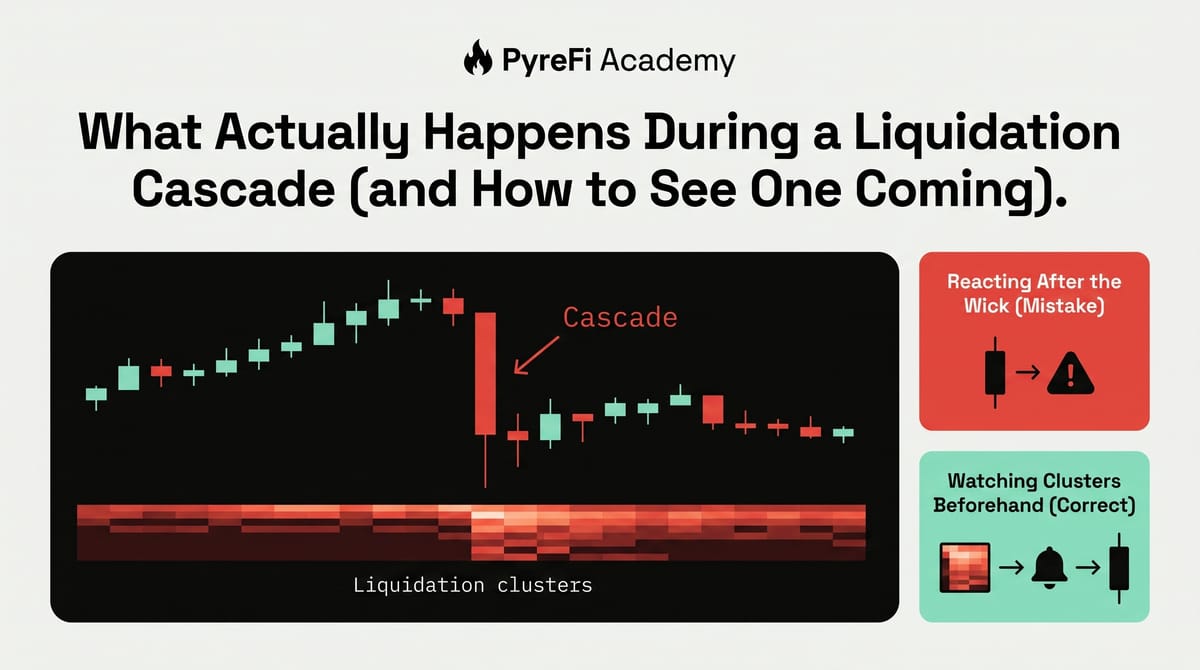
The self-reinforcing wipeouts behind crypto's most violent candles — and the data that flashes red beforehand.
Every crypto trader has seen it: a chart moving normally, then suddenly a violent, near-vertical candle wipes out 10, 20, sometimes 30% in minutes, before partially recovering. It feels random and catastrophic, like the market simply broke. It isn't random. It's a liquidation cascade — a mechanical, self-reinforcing chain reaction — and with the right data, you can often see the conditions for one building before it detonates.
Understanding cascades is essential for two reasons: to avoid being liquidated in one, and to understand the violent moves that dominate crypto price action. Let's break down exactly what happens.
Step one: leverage and liquidation
To understand a cascade, start with a single liquidation. When a trader uses leverage, they borrow to control a position larger than their capital. Their own money is the margin backing the position. If price moves against them enough that their losses approach their margin, the exchange forcibly closes their position to prevent the trader's balance from going negative. That forced closure is a liquidation.
Crucially, a liquidation isn't a normal, voluntary trade. It's a market order dumped onto the book by the exchange's engine to close the position immediately — a long liquidation becomes forced selling; a short liquidation becomes forced buying. The trader has no choice, and the order executes at whatever price it can find.
Step two: the cascade mechanism
Now scale this up. In crypto, leverage is widespread, and positions cluster. Many traders open longs around similar price levels, which means their liquidation prices also cluster in the same zones.
Here's the chain reaction, for a downside cascade:
- Trigger: Price drops enough to hit the first cluster of long liquidation prices.
- Forced selling: Those longs get liquidated — the engine dumps forced sell orders onto the market.
- Price pushed lower: That forced selling drives price down further.
- Next cluster hit: The lower price triggers the next cluster of long liquidations.
- More forced selling: Which pushes price even lower...
- Repeat: Each wave of liquidations fuels the next, accelerating the move.
This is the cascade: liquidations causing price moves that cause more liquidations, in a self-reinforcing loop. It's why the candle goes near-vertical — it's not normal supply and demand, it's a mechanical chain of forced orders firing in sequence. The same works in reverse for a short squeeze (forced buying cascading upward).
The move typically overshoots, because the forced selling temporarily overwhelms all natural buying. Then, once the leverage is flushed and forced orders stop, price often snaps back partway — which is why cascades leave those distinctive long wicks. The wick is the overshoot; the recovery is the market finding real value again after the mechanical panic.
Step three: why crypto is uniquely prone to this
Cascades happen in crypto far more than in traditional markets, for structural reasons:
- High leverage is easily available. Retail can access very high leverage, creating more liquidation-prone positions.
- 24/7 markets with thin overnight liquidity. Cascades often strike during low-liquidity hours, when there aren't enough natural buyers to absorb the forced selling.
- Clustered positioning. Retail tends to pile into the same trades at the same levels, concentrating liquidation prices into vulnerable clusters.
- Interconnected derivatives. Perpetual futures dominate crypto trading, and their leverage is the raw fuel for cascades.
How to see one coming
You can't predict the exact trigger, but you can read when the market is primed for a cascade. The warning signs cluster in derivatives data:
1. High open interest. As covered in OI analysis, high open interest means lots of leverage is loaded into the market. That's the ammunition a cascade needs. Grinding, elevated OI is a prerequisite for a large unwind.
2. Extreme funding rates. Extreme funding reveals dangerously crowded positioning. Very positive funding = overcrowded longs = downside cascade fuel. Very negative funding = overcrowded shorts = upside squeeze fuel. When funding and OI are both extreme, the market is maximally fragile.
3. Liquidation levels clustering nearby. Some analytics visualize where large clusters of liquidation prices sit (often called liquidation heatmaps). When price is approaching a dense cluster, the risk of a cascade triggering at that level rises sharply. Large players are well aware of these clusters — price often gets drawn toward them precisely because that liquidity is a magnet.
4. Approaching a key technical level with leverage stacked. When a heavily-watched support/resistance level coincides with a cluster of liquidation prices, a break of that level can ignite the cascade as it triggers the stops and liquidations sitting just beyond it.
The composite warning: high OI + extreme funding + a nearby liquidation cluster + a key level = a market primed to cascade. You won't know the exact moment, but you'll know to reduce leverage, tighten risk, and not be complacently over-positioned into that setup.
How to avoid being cascade fuel
1. Use less leverage. The simplest and most effective defense. Lower leverage means a wider buffer before your liquidation price, so a cascade is far less likely to catch you. High leverage is precisely what makes you kindling.
2. Don't cluster with the crowd. If funding and OI scream that everyone is crowded long, recognize that your long is part of the vulnerable pile. Position size accordingly.
3. Keep liquidation price far from obvious clusters. If your liquidation price sits right in a dense cluster or just beyond a key level, you're a target. Give yourself room.
4. Respect the warning signs. When the derivatives data shows maximum fragility, that's not the time to add leverage chasing the last bit of a move. That's the time to be defensive.
The opportunity side
Cascades aren't only a danger — they're also where some of the best entries appear. A cascade often overshoots, flushing leverage and briefly pushing price far below (or above) fair value before snapping back. Traders who kept dry powder and stayed unleveraged can buy the capitulation wick — the moment of maximum forced selling — when weaker hands are being liquidated. Being the calm buyer during a cascade, rather than its fuel, is a genuine edge. But it requires having avoided being over-leveraged in the first place.
Why systematic monitoring helps
Tracking OI, funding, and liquidation dynamics across the entire market in real time is exactly what automated market-intelligence is built for. A system watching the full derivatives surface can flag when conditions are aligning for a cascade — high leverage, crowded funding, price approaching a liquidation cluster — across many tokens at once, well before the candle goes vertical. It turns the invisible buildup of fragility into a readable warning. For a human trader, the lesson is the same: watch the derivatives data, not just the price, because the cascade is written in the leverage long before it hits the chart.
The takeaway
A liquidation cascade is a mechanical chain reaction: forced liquidations dump orders that move price, triggering more liquidations, in a self-reinforcing loop that produces crypto's most violent candles. Crypto is uniquely prone to them because of high leverage, thin liquidity, and clustered positioning. You can't predict the exact trigger, but you can read the fragility building — high open interest, extreme funding, and price approaching dense liquidation clusters — and refuse to be over-leveraged into it.
Don't be the fuel. Watch the derivatives data, keep your leverage modest, and keep dry powder for the overshoot. The cascade that wipes out the crowd can be the entry of a lifetime for the trader who saw it coming.
PyreFi tracks open interest, funding, and liquidation dynamics across the whole market, flagging when conditions align for a cascade — turning the invisible buildup of leverage into an early warning.