High Leverage Isn't the Problem
crypto leverage position sizing explained
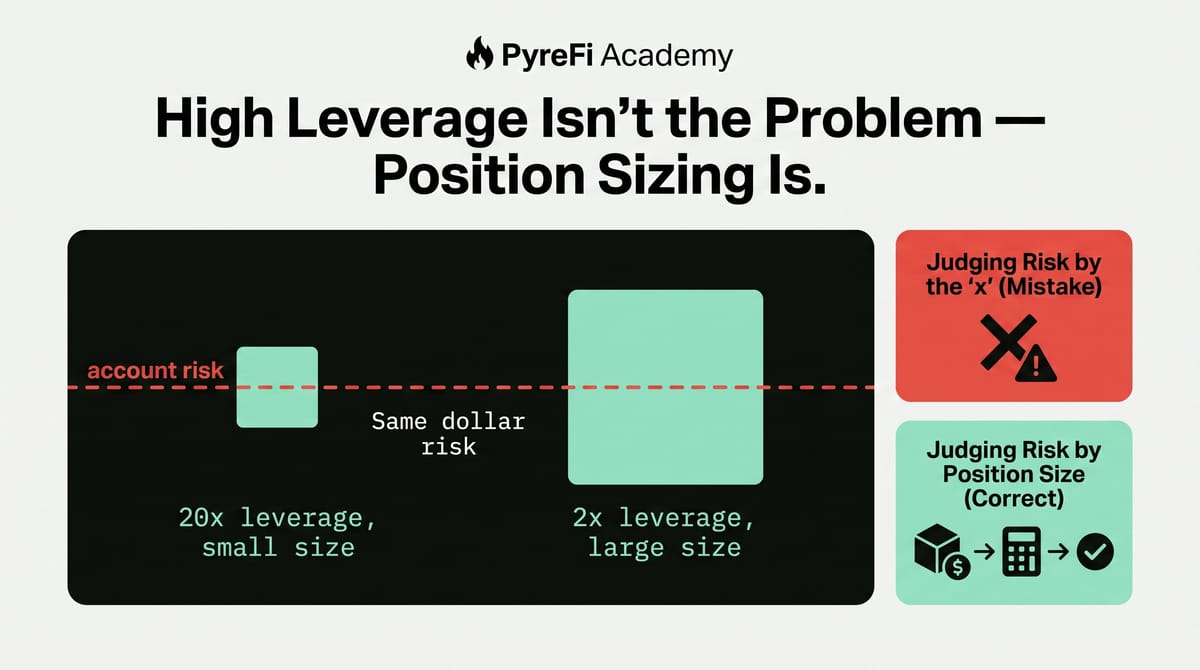
The number next to the "x" isn't your risk. The math most traders never do is.
"Leverage is what blows up accounts." You've heard it a hundred times, and it's almost right — which makes it dangerous, because it points traders at the wrong villain. The number of losing accounts that trace their destruction to "high leverage" is enormous. But leverage itself isn't the killer. The real culprit is position sizing, and confusing the two keeps traders making the same mistake with the leverage dial set lower.
Let's fix the mental model, because it's one of the most important concepts in trading and one of the most widely misunderstood.
What leverage actually is
Leverage lets you control a position larger than your capital by borrowing. At 10x leverage, $1,000 of your money controls a $10,000 position. Your gains and losses are calculated on the full $10,000, so a 1% move in the asset is a 10% move on your capital. Higher leverage amplifies both directions.
The scary part everyone focuses on: with leverage comes a liquidation price — the level at which your losses eat your margin and the position is forcibly closed. Higher leverage means the liquidation price sits closer to your entry, so a smaller adverse move wipes you out.
This is where the "leverage is the problem" belief comes from. And it's why the fix seems obvious: use less leverage. But that fix misunderstands the actual mechanics of risk.
The insight: leverage and position size are separable
Here's the key realization most traders never internalize: the leverage multiplier and the amount of capital you actually put at risk are two different things.
What determines how much you can lose on a trade is not the leverage number — it's: 1. How much capital you commit to the position (position size), and 2. Where your stop loss is (how far price moves against you before you exit).
Leverage affects your liquidation price and your capital efficiency, but it does not, by itself, determine your risk if you use a stop loss and size correctly.
Consider two traders, each with a $10,000 account, who both want to risk exactly $200 (2% of their account) on a Bitcoin trade with a stop loss 4% below entry:
- Trader A uses 2x leverage. To risk $200 with a 4% stop, they need a $5,000 position ($5,000 × 4% = $200). At 2x, that requires $2,500 of margin.
- Trader B uses 20x leverage. To risk the same $200 with the same 4% stop, they need the same $5,000 position — but at 20x, that requires only $250 of margin.
Both traders have the identical risk: $200 if the stop hits. The trade is the same size, the stop is the same distance, the loss is the same. The only difference is that Trader B tied up less margin (freeing capital) but sits with a closer liquidation price.
The leverage number changed. The risk did not. Because risk is determined by position size and stop distance — not by the multiplier.
Where it actually goes wrong
So why do high-leverage traders blow up? Not because of the multiplier itself, but because high leverage tempts two fatal behaviors:
1. Oversizing. The real killer. Given 20x leverage and $10,000, a trader thinks "I can control a $200,000 position!" — and does. Now a mere 5% adverse move wipes the entire account. They didn't lose because of leverage per se; they lost because they took a position twenty times too large for their capital. The leverage enabled the oversizing, but the sin was the size.
2. Trading without a stop, into a tight liquidation. With high leverage, the liquidation price is close. A trader who doesn't set a stop inside the liquidation distance is effectively letting the exchange's liquidation engine be their stop — at the worst possible price, with no buffer. A normal pullback liquidates them.
Both failures are position sizing and risk management failures. Leverage amplified them, but the root cause was committing too much capital and not defining the exit.
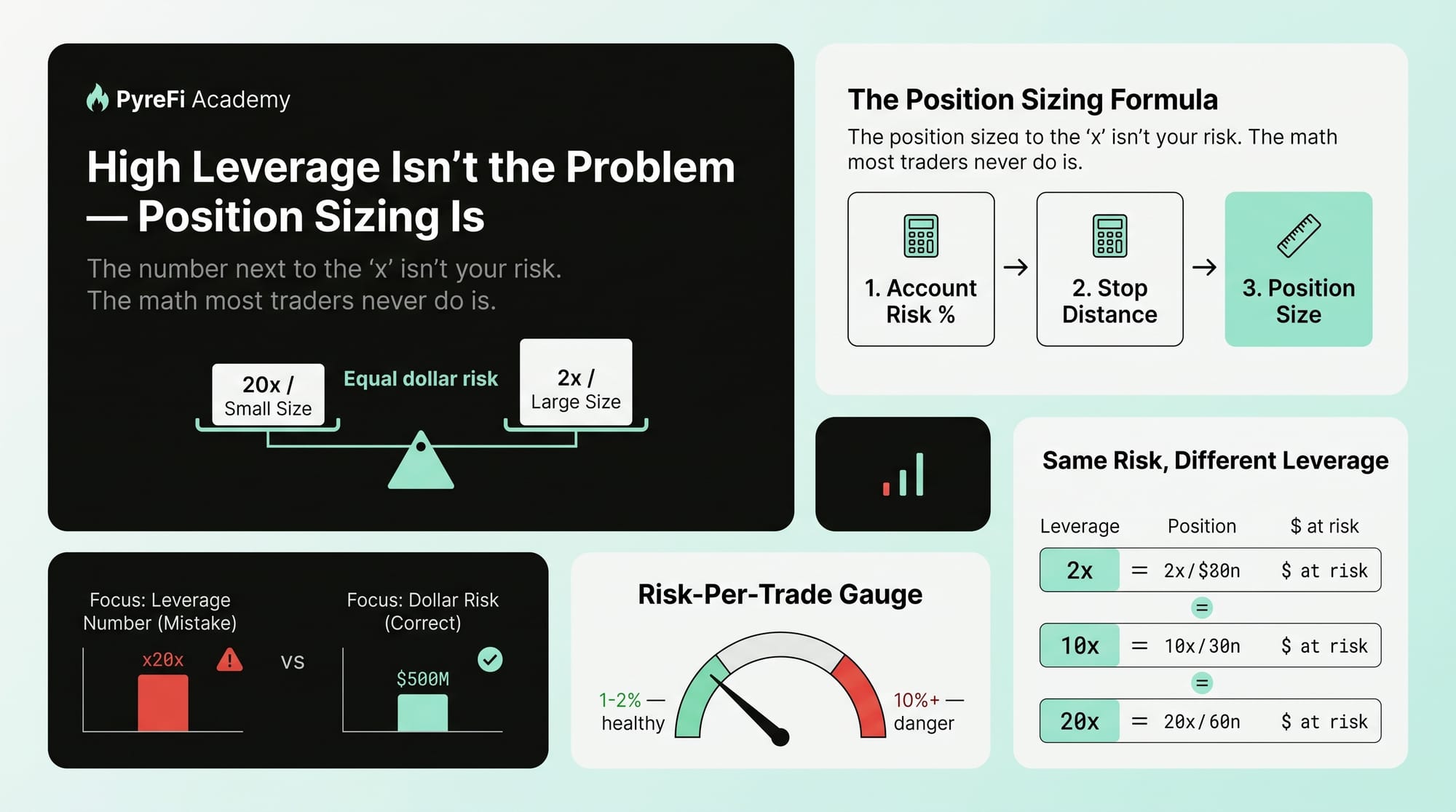
The correct way to think about it
Flip the whole process around. Instead of "how much leverage should I use?", ask these questions in order:
- How much am I willing to lose on this trade? (e.g., 1–2% of your account — a fixed risk budget.)
- Where is my stop loss? (Based on structure — where the trade idea is invalidated.)
- What position size makes those two consistent? (Risk budget ÷ stop distance = position size.)
- What leverage does that position size require, given my capital? (This is the last question, and it's just an efficiency detail.)
Notice that leverage falls out at the end, as a byproduct — not a starting decision. When you size from your risk budget and stop, the leverage number becomes almost incidental. You use whatever multiplier lets you hold the correctly-sized position, ensuring your stop sits well inside your liquidation price.
The one real caveat about high leverage
There is a legitimate reason to be cautious with very high leverage even when sizing correctly: it places your liquidation price close to entry, so a sudden wick — common in crypto's volatile, sometimes manipulated markets — can liquidate you before your stop would have triggered, on nothing but noise. A sharp stop-hunt wick can blow through a tight liquidation while a wider-leverage position with the same dollar risk would have survived and let the stop do its job.
So the practical guidance: size from your risk budget first, and then use moderate leverage that keeps your liquidation price comfortably beyond your stop, with room for crypto's characteristic volatility. High leverage isn't forbidden — it's just that pushing the multiplier to extremes shrinks your buffer against noise for no gain in a properly sized trade.
The takeaway
"Leverage blows up accounts" is a comforting oversimplification that keeps traders making the real mistake — oversizing — with the dial turned down. Risk on a trade is determined by position size and stop distance, not by the leverage multiplier. Two traders with wildly different leverage can carry identical risk if they size correctly.
Stop asking "how much leverage?" Start asking "how much am I willing to lose, where's my stop, and what size makes those consistent?" Let leverage be the last, incidental answer — set moderately, with room for crypto's wicks. Do that, and you'll have addressed the villain that actually destroys accounts: not the multiplier, but the size.
Risk management is a discipline PyreFi builds into every signal — entry, target, and invalidation together — so a trade is defined by where it's wrong, not by how much leverage you can stack on it.