Volume Tells the Truth When Price Lies: A Practical Guide to Reading Volume
how to read volume in crypto trading
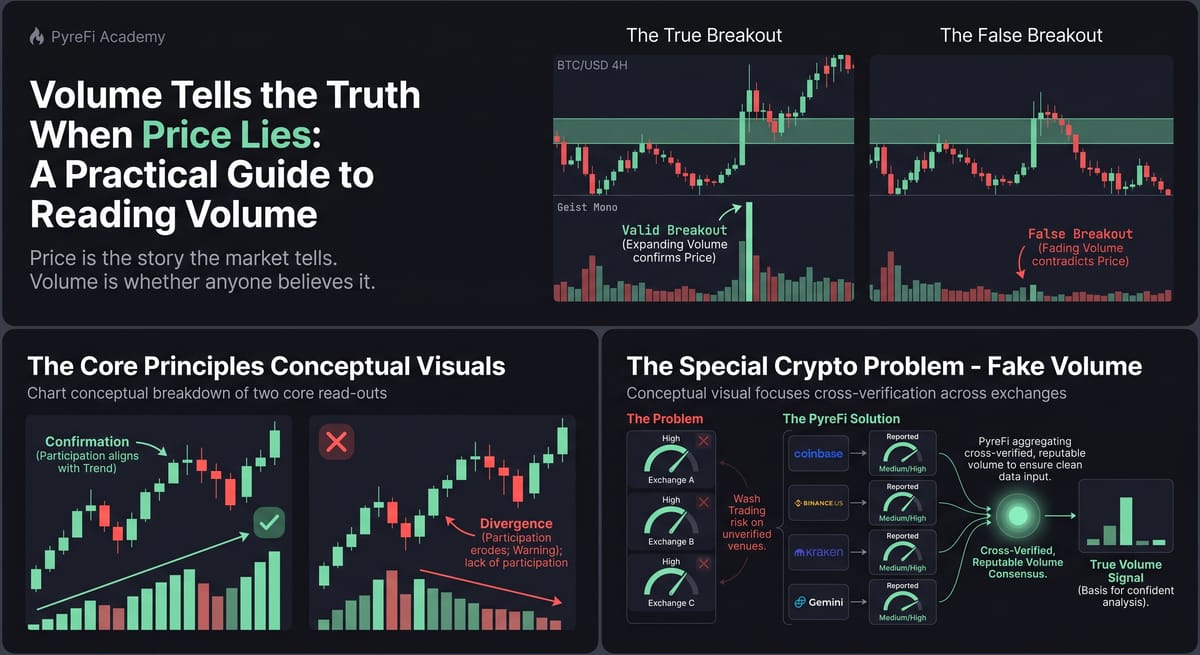
Price is the story the market tells. Volume is whether anyone believes it.
Two charts show the exact same breakout: price pushes above resistance on a clean green candle. On the first chart, the breakout holds and price runs. On the second, it immediately collapses back into the range, trapping everyone who bought. The price action looked identical. The difference was invisible unless you were looking at one thing: volume.
Price tells you what happened. Volume tells you whether it mattered. Learn to read the two together and you'll avoid a huge share of the traps that catch traders who only watch the candles.
What volume actually is
Volume is the number of units traded in a given period — how many coins changed hands during that candle. Every trade requires a buyer and a seller, so volume isn't "buying" or "selling" per se; it's participation. High volume means a lot of conviction and activity flowing through that price level. Low volume means apathy — few people cared to transact.
That single concept — participation — is the key to everything volume can tell you.
The core principle: volume confirms price
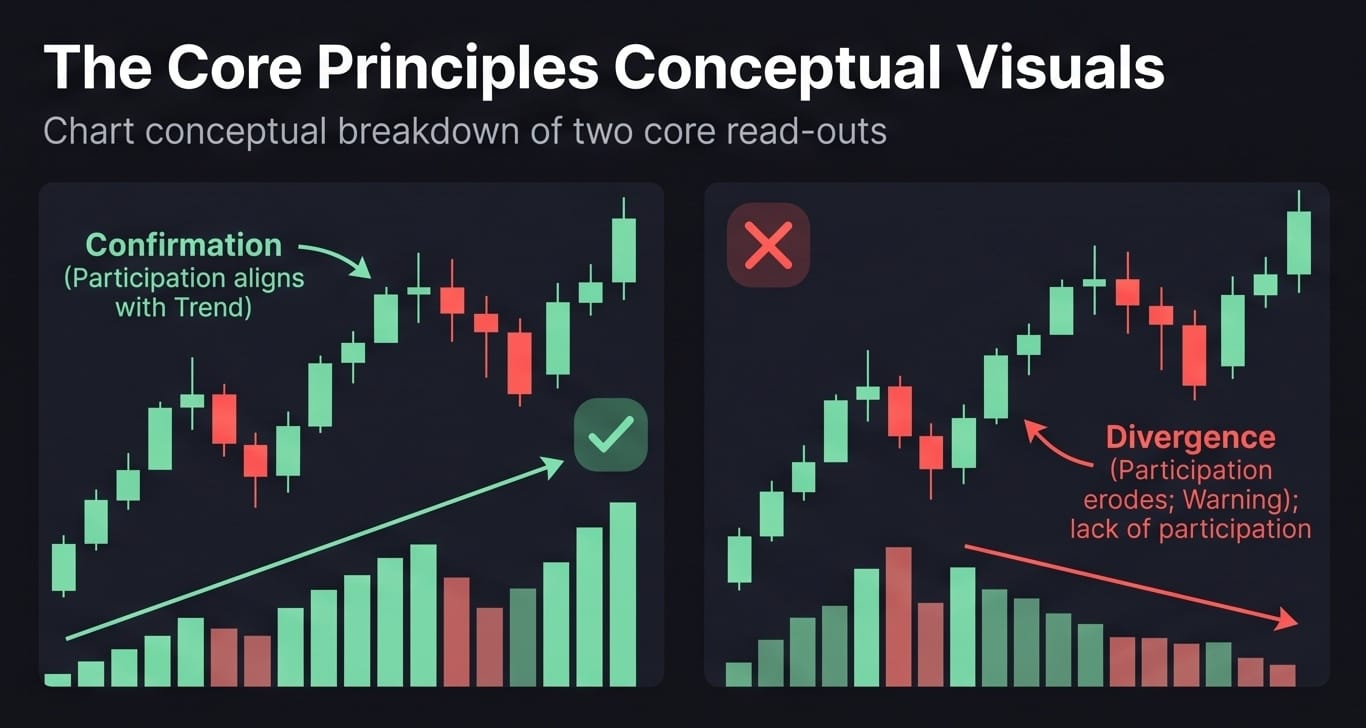
The foundational rule is simple: a price move backed by high volume has conviction; a price move on low volume is suspect. From this one idea, a set of practical reads follows.
Breakouts. When price breaks a key level on a surge of volume, real participants are stepping in — the move has fuel. When price breaks the same level on thin volume, it's often a handful of traders or a low-liquidity blip, and it tends to fail. The high-volume breakout is worth trusting; the low-volume one is worth fading or ignoring.
Trends. A healthy uptrend shows rising or steady volume on the up-moves and lighter volume on the pullbacks — buyers are committed, sellers are just taking profits. When a trend's up-moves start coming on declining volume, the trend is losing participation. It may continue for a while, but its foundation is eroding.
Reversals. Major turning points are frequently marked by a volume spike — a climax. A capitulation bottom often prints an enormous red candle on record volume as the last holders panic-sell to buyers who are absorbing everything. Blow-off tops do the mirror image. These volume climaxes mark where one side finally exhausts itself.
Volume "tells" that expose lies
Once you internalize confirmation, you can start spotting the specific ways price lies and volume tells the truth.
The low-volume rally into resistance. Price drifts up toward a known resistance zone on quietly fading volume. This is weak — there's no real buying pressure, just a lack of sellers. It's far more likely to reject than a high-volume approach. Great short setup context; terrible place to chase longs.
The high-volume rejection. Price hits a level and reverses hard on a massive volume spike. That spike is a large participant (or many) defending the level aggressively. It's a strong signal that the level is real and being contested by serious money.
The volume dry-up before a move. Sometimes volume contracts to unusual lows as price coils into a tight range. This apathy often precedes a large expansion — the market is holding its breath. Combined with a Bollinger Band squeeze, it's a classic "big move coming" setup, though it won't tell you the direction.
The unconfirmed new high. Price makes a fresh high but volume is noticeably lower than at the previous high. Fewer participants are willing to buy up here. This "volume divergence" is an early warning that the move is running on fumes.
The special problem of crypto volume: it can be faked
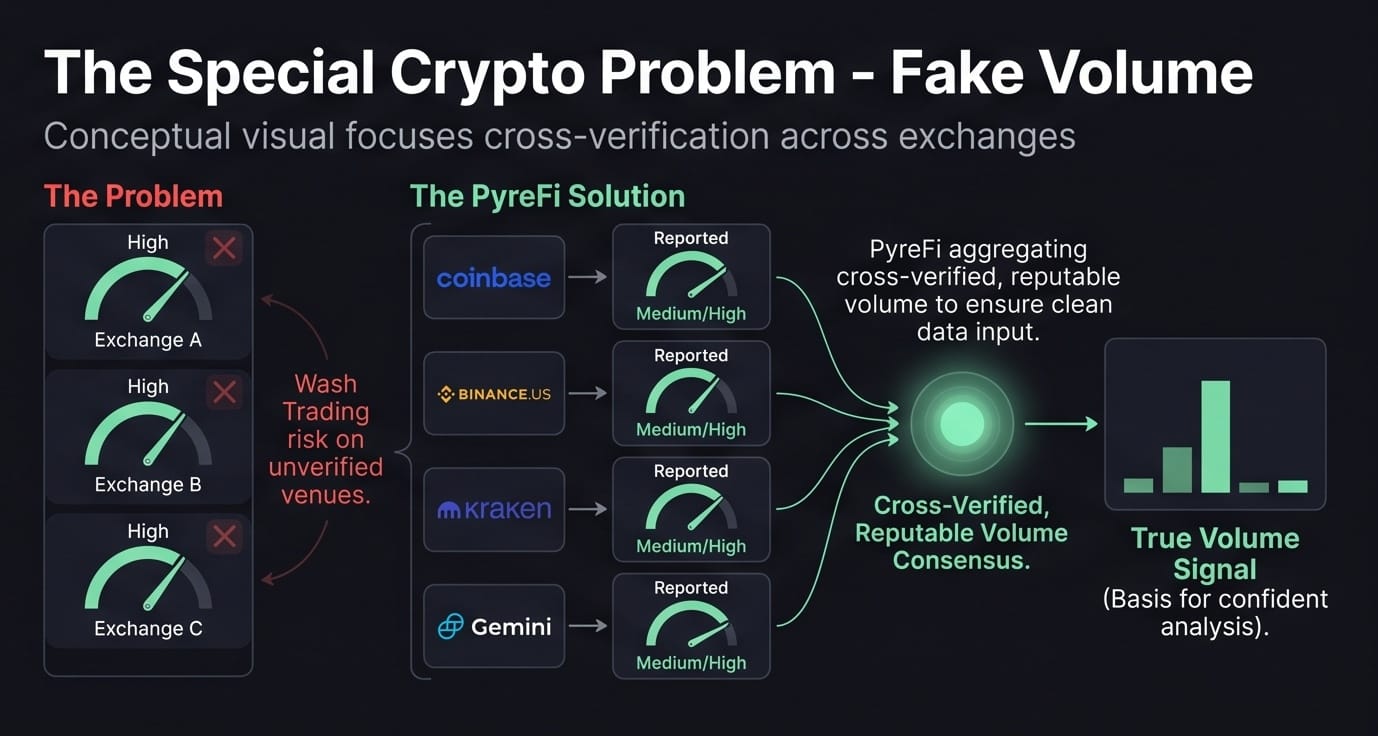
Here's where crypto demands extra skepticism. In traditional regulated markets, reported volume is trustworthy. In crypto, it isn't always. Some exchanges have historically inflated their volume through wash trading — the same entity buying and selling to itself to manufacture the appearance of activity and liquidity.
This matters enormously, because volume analysis is only as good as the volume data. A "high-volume breakout" on an exchange with fake volume is meaningless. Practical defenses:
- Trust volume on major, liquid exchanges more than on obscure ones.
- Cross-check across venues. Real moves show up in volume across multiple reputable exchanges, not just one.
- Be suspicious of tokens where volume looks huge relative to their liquidity — a thin order book with enormous reported volume is a red flag.
This is one reason serious market-intelligence systems are so careful about which venues they trust and how they aggregate volume across exchanges. Clean, cross-verified volume is the input that makes every other read reliable; garbage volume corrupts the whole analysis.
A practical volume workflow
- Always have volume bars on your chart. Not as an afterthought — as a permanent second layer under every candle.
- On every important candle, ask one question: did volume confirm this move? A breakout, a reversal, a new high — each is only as trustworthy as the volume behind it.
- Watch for divergence: new price highs on lower volume, or trends advancing on shrinking participation. These are early exhaustion warnings.
- Respect volume climaxes at extremes — they often mark capitulation or blow-off turning points.
- Sanity-check the source. Prefer liquid, reputable venues and cross-verify surprising volume across exchanges before trusting it.
Volume in context, not in isolation
Like every tool, volume is strongest as part of a confluence rather than alone. High volume by itself doesn't tell you direction — a volume spike can mark a breakout or a reversal. What makes volume powerful is pairing it with structure and price action: high volume at a key support zone on a rejection candle is a far more complete signal than any one of those elements alone.
Think of volume as the lie detector you run on every price move. Price proposes; volume decides whether to believe it.
The takeaway
Price is the headline; volume is the fact-check. A move with volume behind it is a statement the market is making with conviction. A move without volume is a whisper that's easy to mistake for a shout. The breakouts that trap traders, the rallies that quietly die, the reversals that catch everyone off guard — most of them were visible in advance to anyone reading the volume.
Put volume bars on every chart. Ask, every time, whether participation confirms the price. And in crypto especially, make sure the volume you're reading is real. Do that consistently, and you'll stop getting fooled by prices that lie.
PyreFi cross-verifies volume across trusted exchanges and weighs it alongside structure and derivatives data — because a signal built on fake or unconfirmed volume is a fake signal.