Funding Rates Explained: The Hidden Fee That Reveals What Traders Really Believe
crypto funding rates explained
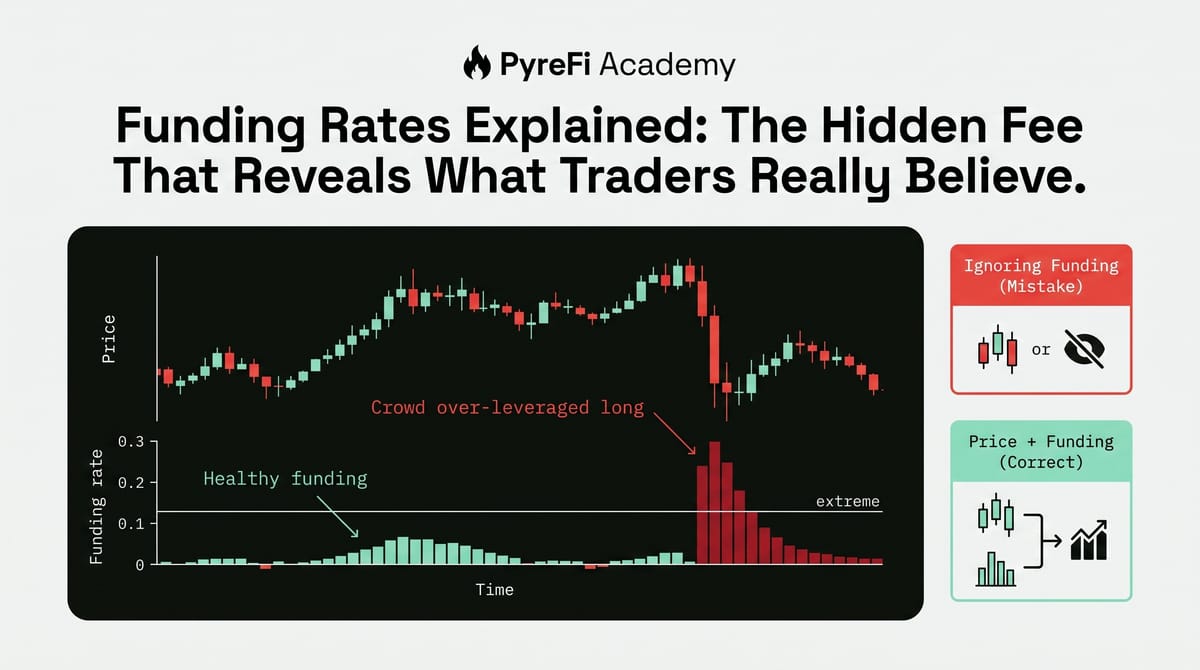
A small periodic payment that quietly exposes crowd positioning — and warns you before it unwinds.
There's a fee in crypto derivatives that most beginners never notice and most professionals watch obsessively. It's called the funding rate, and it does two things at once: it quietly charges (or pays) you for holding a leveraged position, and it broadcasts, in a single number, what the crowd actually believes about where price is going.
Learn to read funding rates and you gain a window into positioning that pure price charts can't show you — including an early warning for the violent unwinds that catch everyone else off guard.
The problem funding rates solve
To understand funding, you first need to understand perpetual futures — the dominant instrument in crypto trading. A perpetual future ("perp") is a derivative that lets you trade an asset with leverage and no expiry date. You can hold it indefinitely, unlike traditional futures that settle on a set date.
But this creates a problem. Traditional futures converge to the spot price at expiry — that's what anchors them to reality. Perps never expire, so what keeps a perpetual's price tethered to the actual spot price of the asset? Without a mechanism, the perp could drift far from reality.
That mechanism is the funding rate.
How funding actually works
The funding rate is a small periodic payment exchanged directly between traders — longs and shorts — typically every eight hours (though it varies by exchange). Critically, the exchange doesn't collect it; it flows between position holders. Here's the logic:
- When the perp trades above spot (more aggressive buyers, market leaning long), funding is positive. Longs pay shorts. This creates a cost to being long and an incentive to short, nudging the perp price back down toward spot.
- When the perp trades below spot (market leaning short), funding is negative. Shorts pay longs. This costs shorts and rewards longs, nudging price back up toward spot.
The size of the rate scales with how far the perp has diverged from spot. A small divergence means small funding; a large one means large funding. It's a self-correcting tether, paid by whichever side is crowded.
Why funding reveals belief
Here's the insight that makes funding so valuable: the funding rate is a real-money vote on positioning. Traders aren't just saying they're bullish — they're paying, out of pocket, to hold that position. That makes funding a far more honest sentiment gauge than social media chatter or survey polls.
- Strongly positive funding means longs are so eager they're willing to pay a continuous fee to stay long. The market is crowded to the upside.
- Strongly negative funding means shorts are paying to stay short. The market is crowded to the downside.
- Funding near zero means positioning is balanced — no strong crowd lean.
Because it's backed by actual payments, funding cuts through the noise. It tells you not what people say, but what they're paying for.
The contrarian signal: crowded trades unwind
Now the actionable part. Extreme funding is one of the most reliable contrarian warning signals in crypto, and here's why.
When funding is extremely positive, it means the market is dangerously crowded long — nearly everyone who wants to be long already is, and they're all paying to stay there. This is a fragile setup. There are few new buyers left to push price higher, and a huge pool of leveraged longs vulnerable to liquidation. A relatively small drop can trigger long liquidations, which push price lower, triggering more liquidations — a long squeeze. The crowd that was so confident becomes forced sellers.
The reverse applies to extreme negative funding: an overcrowded short side is fuel for a short squeeze, where a small rally forces shorts to buy back, accelerating the move up.
This is the paradox of funding: the more one-sided and confident the positioning, the more vulnerable the market is to a violent reversal in the opposite direction. Extreme funding doesn't tell you the exact top or bottom, but it tells you the market is stretched and primed for a snap-back. Many of crypto's most violent moves are precisely these unwinds of crowded, over-funded positioning.
How to actually use funding rates
1. As a sentiment thermometer. Check funding to gauge the crowd's lean. Persistently positive funding during a rally confirms strong bullish positioning — but also rising fragility. Watch how it evolves.
2. As a contrarian warning at extremes. When funding reaches unusually high or low levels for that asset, treat it as a flag that the market is stretched and a squeeze is possible. Don't blindly fade it (crowded can get more crowded), but tighten risk, watch for reversal confirmation, and be ready for a violent unwind.
3. As a cost you're actually paying. If you hold leveraged positions, funding is a real expense (or income). Holding a long through persistently high positive funding steadily bleeds your position. On the flip side, sophisticated traders sometimes structure positions to collect funding — more on that in strategies like basis trading.
4. In combination, never alone. Funding is one input. Extreme funding plus a key resistance zone plus bearish momentum divergence is a far stronger signal than funding by itself. Confluence, always.
A common mistake: fading funding too early
The classic error is treating extreme funding as an immediate reversal trigger — shorting the instant funding gets high. But an overcrowded market can become more overcrowded, and funding can stay extreme for a while as a trend runs. Funding tells you the market is fragile and stretched, not that it will reverse right now. Wait for price action to confirm the turn (a break of structure, a rejection at resistance) before acting on the contrarian read. Use funding to know where to be alert, and price to know when to act.
Why this is PyreFi's home turf
Funding rates, and derivatives data generally, are underappreciated by retail traders who fixate on spot price charts — yet they often move before spot does. Positioning stress shows up in funding before it shows up in a candlestick. This is exactly the kind of data a serious market-intelligence system integrates: monitoring funding across the full market to spot where positioning is dangerously stretched, and folding that context into its read of every asset. A signal built on spot price and funding context is far richer than one built on price alone — because it knows not just where the market is, but how it's positioned, and therefore how it might snap.
The takeaway
The funding rate is the hidden fee that reveals what traders really believe — because they're paying real money to hold their conviction. Positive funding means the crowd is long and paying for it; negative means the crowd is short and paying for it. And the extremes matter most: an over-funded, overcrowded market is fragile, primed for a violent squeeze in the opposite direction.
Most retail traders never look at funding. Start looking, and you'll see positioning stress building before it erupts into the moves that surprise everyone else. That's not a small edge — it's a window into the mechanics beneath the price.
PyreFi monitors funding rates across the full market and folds positioning context into its read of every token — surfacing where the crowd is dangerously stretched before the unwind hits the chart.